
Calculator - Microfluidic Flow Rate & Pressure Drop
This calculator estimates back pressure, flow rate and Reynolds number for laminar flow in microfluidic channels. It supports constant flow rate and fixed pressure systems using Hagen-Poiseuille-based calculations.
About this calculator
This calculator estimates the relationship between pressure drop and flow rate in microfluidic channels under laminar flow conditions. It can be used for constant flow rate systems, where the required back pressure is calculated, or fixed pressure systems, where the resulting flow rate is estimated.
It also calculates Reynolds number to help assess whether the laminar flow assumption is appropriate.
Laminar flow and Reynolds number
Laminar flow occurs when a fluid moves in smooth, parallel layers. In microfluidic channels, this is usually the expected flow regime because viscous forces dominate over inertial forces.
Reynolds number compares these two effects and helps indicate whether the flow is likely to remain laminar. This calculator is intended for laminar flow conditions; other models may be required for transient or turbulent flow, typically where Re > 2300.
Calculation basis
The calculations are based on the Hagen-Poiseuille relationship for incompressible Newtonian fluids.
For circular channels, the pressure-flow relationship is:
$$\Delta P = \frac{8 \mu L Q}{\pi R^4}$$
For rectangular or near-rectangular channels, the calculator uses:
$$\Delta P \approx \frac{12 \mu L Q}{w h^3 \left( 1 - 0.63 \frac{h}{w} \right)}$$
Where:
- ΔP = pressure drop across the channel
- μ = dynamic viscosity of the fluid
- L = channel length
- Q = volumetric flow rate
For circular channels:
- R = channel radius
For rectangular channels:
- w = channel width, typically the larger dimension
- h = channel height, typically the smaller dimension
Channel geometry
The calculator supports circular and rectangular channel cross-sections.
Circular channels are typically used for capillaries, needles, tubing and round glass channels. Rectangular or near-rectangular channels are common in PDMS chips, injection moulded polymer devices, milled channels and many lab-on-a-chip systems.
Choosing the correct cross-section is important because channel geometry affects hydraulic resistance and therefore the pressure-flow relationship used in the calculation.
When to use it
This calculator can support early-stage microfluidic design, channel sizing, pump selection, pressure controller settings and system integration.
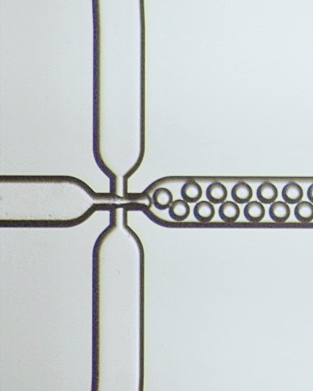
Pressure drop and flow rate are important in applications such as reagent delivery, droplet generation, cell culture, particle production and lab-on-a-chip development.
In real devices, performance may also be affected by manufacturing tolerances, fittings, bubbles, surface properties, channel deformation and non-Newtonian fluid behaviour.
Sources:
- Bruus, H. (2014) Microscale Acoustofluidics. Royal Society of Chemistry. Accessed from https://books.rsc.org/books/edited-volume/1076/chapter/901085/Governing-Equations-in-Microfluidics
Tool feedback
We would love to hear from you! How was your experience with this tool? If you have any feedback on functionality/ UI or would like to request a new calculator feature, please fill in this form to help us improve!
.png)
.gif)